 |
 |
 |
Objectives
Chronic
Obstructive Pulmonary Diseases, including chronic bronchitis and emphysema,
are of growing importance in Europe due to environmental factors, industrial
influences, increasingly aged population and smoking habits. These diseases
can be detected by conventional tests only when already very pronounced. The
project has demonstrated the potentialities and the validity of a new non
invasive method for the study of selected COPD, the typical end stage of which
is emphysema (loss of alveolar structure, reduced ventilation due to loss
of lung elasticity).
Description
The
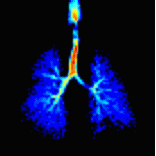
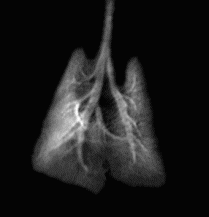
method is magnetic resonance imaging using hyperpolarized helium-3 gas
inhaled in the lungs. This harmless procedure can provide information on airspace
morphology (3D anatomical images of excellent resolution), distribution of
ventilation (fast scans during inspiration and washout) and lung structure
or function (parametric maps).
The PHIL project has coordinated the complementary efforts of 9 European research
teams from 6 countries to carry out a clinical study (116 patients, 37 volunteers),
to work on animal models (2 types of emphysema) and to improve the methodology
(production of polarised gas, MRI techniques).
Results
The PHIL
project has contributed to the validation of this new non invasive method
for early diagnosis, differentiation and staging of COPD. The achieved methodological
developments will favour the dissemination of the technique. The short-term
perspectives are transfer to clinics and industrial exploitation (contrast
agents and drug companies, MR manufacturers).
Summary
of the final report 
"Polarized
Helium to Image the Lung",
by G. Tastevin
(GDR 2144, Grenoble, 2004)
"Imaging
Emphysema - Helium-3 MR Imaging",
by E.J.R.
van Beek (IWPFI, Heidelberg, 2006)
Prospects
The PHIL
Consortium has undertaken successful efforts to allow further development
of hyperpolarized Helium3 MRI and dissemination of this innovative, powerful,
non-invasive technique. Under the 6th
Framework Program, a Marie
Curie Research and Training Network called PHeLINet
has been set-up (Polarized Helium Lung Imaging
Network, 2007-2011).
PHELINET is designed to meet the major needs of end-users, driving increased
academic cooperation and active transfer of knowledge to industry in Europe.
It involves 11 academic partners from 7 countries and 6 industrial partners.
The research program is focused on cutting-edge developments and applications
of hyperpolarized Helium3 MRI for clinical diagnosis and validation of lung
therapies. The training program is planned to provide high level multidisciplinary
scientific education and complementary skills to the 18 new researchers to
be recruited.
PHeLINet job opportunities: see the PHeLINet web page or the Host Fellowships/RTN search tool
PHeLINet
at a glance : low resolution
poster
(0.38 Mb) / high resolution
poster
(2.5 Mb)
Home
last updated on May28th,
2007 by P.J. Nacher